Els criteris expansius de l'art contemporani varen anar prenent força progressivament a les Biennals, Documentas i altres esdeveniments de tesi, que incorporaren àmbits creatius en la perifèria de la tradició de les arts plàstiques i visuals. Fou així com els projectes expositius centrats en la gastronomia, l'urbanisme, l'arquitectura, el disseny, l'edició, l'artesania, els treballs documentals de caràcter social i etnogràfic i, entre d'altres, la dansa, la performance o el teatre experimental, van anar ocupant un espai propi a les programacions de museus i centres artístics. És aquesta una via que ja havien encetat Dadá i el surrealisme, i en la qual podem incloure també les intervencions d'artistes com Picasso, Miró i altres en edificis sacres i profans, així com les creacions tèxtils per a l'alta costura o les seves escenografies per al món de la dansa, l'opera i el teatre. En aquests tipus de mostres, l'acte de veure ens du obligatòriament més enllà dels murs de l'espai expositiu, perquè el que hi ha darrere del que s'exposa sol ser molt més del que veiem. Tanmateix, si bé no es pot replicar el dinamisme de la seva posada en escena en viu, aquestes propostes —concebudes en forma d'instal·lacions multidisciplinàries— permeten descobrir com germinen i prenen forma les idees, endinsant-nos en els processos dels quals romanen objectes i elements de caràcter documental.
“BEFORE THE WORDS. REFUGI TEMPORAL”. Col·lectiu Mal Pelo
Comissariat: Mal Pelo en diàleg amb Imma Prieto
Fins al 28 d'agost de 2022
“LES REGLES DEL JOC”. Maria Ruido.
Comissariat: Imma Prieto
Fins al 4 de setembre de 2022
“MENTRE ARRIBA LA TEMPESTA”. Mounir Fatmi
Comissariat: Fernando Gómez de la Cuesta
Fins al 19 de juny de 2022
Tres exposicions recentment inaugurades a Es Baluard reforcen l’aposta del museu per treballs d’artistes o col·lectius que revisen críticament els temps i les societats actuals com, amb criteris i recursos ben diferents, ho fan María Ruido i Mounir Fatmi. A més, l’exposició del col·lectiu Mal Pelo posa l’accent en l’experiència del cos i la diversitat plàstica del teatre experimental, amb la memòria visual de l’univers creatiu i conceptual d’aquest grup català de llarga trajectòria i indubtable prestigi i compromís amb la cultura en totes les seves manifestacions materials i immaterials. Tant per la seva ubicació en un lloc preferent del museu com per la seva ambiciosa producció i presentació, en la qual sobresurten dues instal·lacions de gran format fetes expressament, cal suposar que “Before the Words. Refugi temporal” tindrà continuïtat amb altres exposicions similars.

Imma Prieto, comissària del projecte de Mal Pelo junt amb els codirectors Pep Ramis i María Muñoz, concep aquesta mostra com una “invitació als cossos dels visitants”, fent-los part d’aquest lloc “acollida i refugi, recorregut per universos escènics plurals que habiten durant un període de temps un altre lloc”. Mal Pelo és un grup de creació escènica actiu des de 1989 caracteritzat per l’autoria compartida i el desenvolupament de projectes multidisciplinaris que Ric Allsopp, autor del text “De la mà, del peu...”, qualifica d'"imatges coreogràfiques", és a dir, posades en escena que reverberen la memòria d’experiències, i on “la materialitat i la fisicalitat del lloc i el record ... s’experimenten com quelcom extern a nosaltres”.
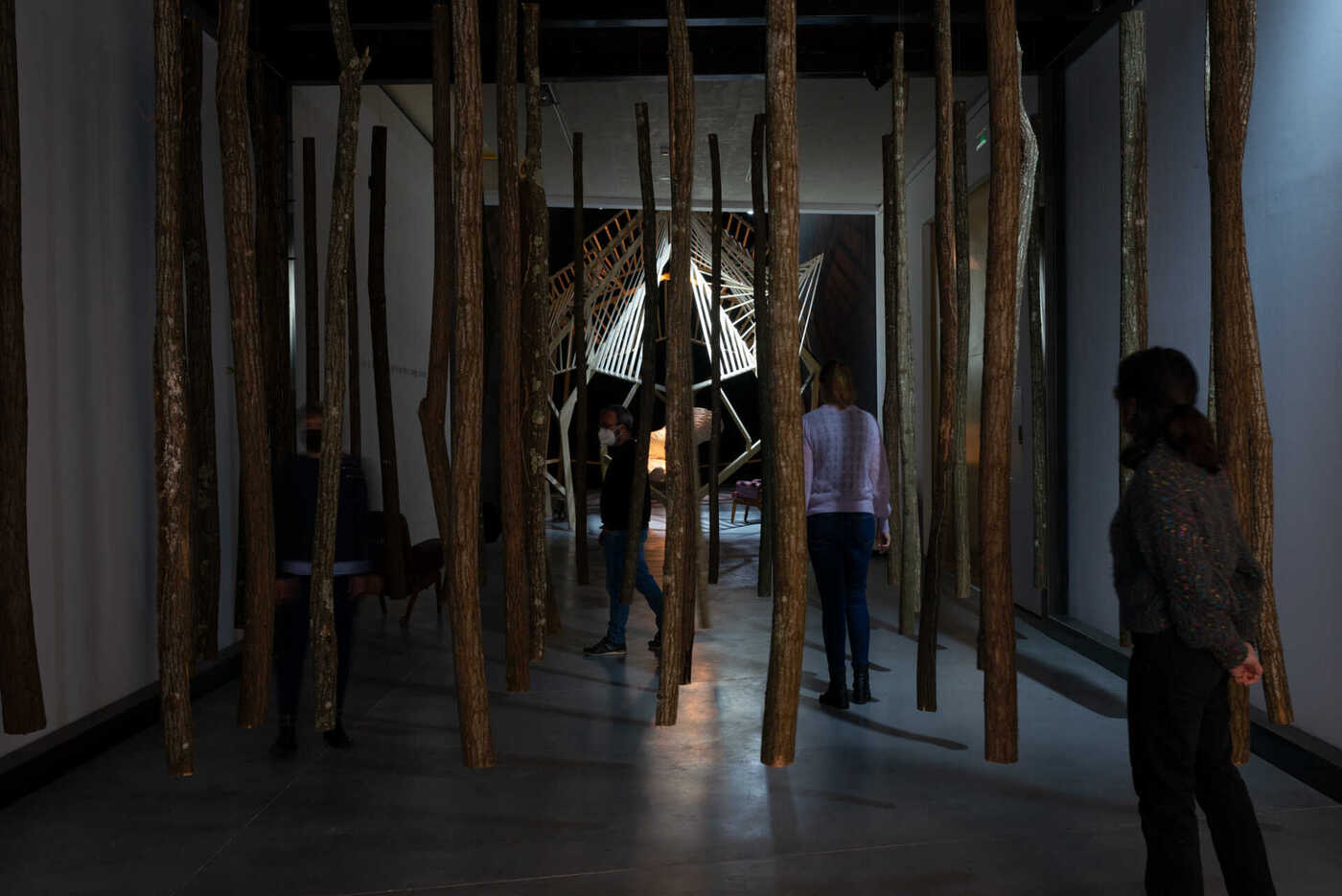
Cal assenyalar la inclusió de nombrosos materials —dibuixos, vídeos, objectes, papers, llibres— que ajuden a visualitzar la importància del “darrera escena”, és a dir, un enorme treball de recerca, discussió, posada en comú i construcció d’aquella idea original que desemboca en el projecte acabat. Sobresurten en el conjunt dues instal·lacions de gran format: un bosc sospès — que ens recordà momentàniament la cèlebre Foresta Sospesa de Fabrizzio Plessi— i la monumental estructura del llaüt obra d’un mestre d’aixa mallorquí, sens dubte un dels elements etnogràfics més representatius del patrimoni marítim balear.

En el mateix nivell del museu es presenta “Les regles del joc”, títol de l’exposició de María Ruido (Orense, 1967), prestigiosa artista i investigadora cultural reconeguda internacionalment pels seus rigorosos treballs sobre “la construcció social de cos i la identitat, sobre el sistema de treball en el capitalisme post fordista i la construcció de la memòria col·lectiva”. El context de pensament de l’artista és el desclassament que caracteritza aquesta societat de la informació en la qual els individus entren en conflicte amb les classes dominants. La culpa, la por, la necessitat. Els somnis, els desitjos. Les noves subjectivitats, la fragilitat de les aspiracions, possiblement amagades. La dispersió i l’extinció dels espais d’intimitat, les llibertats minvades, la vulnerabilitat. Qui som i què determina el context laboral i social al qual pertanyem. Converses, testimonis, ficcions. I el treball artístic com a mètode crític per pensar aquest “estat del malestar” que estreny progressivament les nostres possibilitats d’aconseguir estabilitat, felicitat potser. Tot això i més és el que es percep del treball de Ruido i el que es desprèn del seu diàleg amb Brigitte Vasallo en el vídeo projectat en gran format sobre el mur de la sala.

A més de guions de pel·lícules, publicacions, alguns collages i un diagrama en el qual Ruido descriu les connexions entre el món del treball del proletariat i les classes dominants, la seva mostra inclou quatre vídeos significatius de la trajectòria de l’artista: "La memòria interior" (2002), "Temps real" (2003), "Ficcions amfíbies" (2005) i "ElectroClass" (2011). Malgrat tot, i un cop més, és impossible abastar la magnitud de la trajectòria de Ruido. Cal temps i una atenció recollida per tal d'entreveure la profunditat i coherència del pensament d'aquesta valenta activista compromesa en el canvi de les (desiguals) regles del joc .
Un interessant contrapunt a aquestes mostres la posa la individual de Mounir Fatmi (Tànger, 1970), que ha comissariat Fernando Gómez de la Cuesta. Un projecte que ens situa davant les contradiccions pròpies del nostre temps, un període “de trencament” que contempla la col·lisió del vell i el nou, l’evanescència de la memòria i del fet matèric i, col·lateralment, l’esfondrament de les identitats culturals singulars davant l’emergència de les homogeneïtats globalitzadores conseqüència de les noves pràctiques socials. Un vertader preludi a aquella “tempesta” que tal vegada s’endurà moltes de les coses que (encara) ens identifiquen.

Si l’arqueologia de les comunicacions és un dels rerefons conceptuals més importants en l’obra de Fatmi, hem d’assenyalar la senzillesa i rotunditat de la instal·lació “Dins el cercle de foc” (2017-2022), recreat expressament per Es Baluard. Amb un conjunt d’antigues màquines d’escriure connectades entre si per un caramull de cables vermells i negres i uns papers blancs llençats per terra, Fatmi planteja no només l’enorme diferència dels dos mons confrontats que ell superposa sinó que reflecteix sobre “la construcció de la història, els seus condicionants, els interessos que la regeixen i les manipulacions que emanen del poder dominant”.
Segons el comissari, Fatmi aborda “l’elaboració de tots els relats que ja fa temps que ens sotmeten, unes narracions que, des d’una violència física i intel·lectual, han marcat el nostre passat i condicionen el nostre futur.” Una línia de treball que encoratja a demanar-nos quin és el nostre paper en aquesta situació on fins i tot els objectes, els medis, les xifres, les dades, les estadístiques o els símbols gràfics esdevenen un llenguatge incomprensible. Aquest és l’argument que l’artistadesenvolupa a “El punt de No Retorn” (2022), títol de la peça que utilitza la vibració de la cal·ligrafia, les formes plàstiques i el llenguatge del rectangle pictòric -freqüents de molts dels seus treballs-, per crear un galimaties visual metafòric de la nostra confusió davant la manipulació i sobresaturació de la (des)informació actual.

Aquesta combinació de recursos lligats a les tradicions de la pintura i l’escultura, així com a les arrels culturals i a l’artesania, es troba representada en la petita escultura de ceràmica i el tríptic fotogràfic “La cama negra de l’àngel” (2011). Inspirat en la pintura de Fra Angelico “La curació del diaca Justinià” —obra del segle XV que representa als sants i màrtirs germans, Cosme i Damià, àrabs de naixement— aquest intel·ligent negatiu fotogràfic introdueix la qüestió del racisme, el mestissatge i els conflictes i prejudicis religiosos. Una línia d’investigació que reforça “Poemes: L’exposició perduda” (2022), vídeo de caràcter autobiogràfic que tracta d’aquest món dividit en “una absurda dialèctica de blocs”.
Finalment, el vídeo en blanc i negre “La història no és meva” (2013) converteix els espectadors en observadors (i còmplices?) de la violència mostrada, obligant a demanar-nos quina és la nostra postura personal davant aquesta “tempesta” social, política, econòmica, religiosa i cultural que ens està, ara sí, caient al damunt.
ENGLISH TRANSLATION
ES BALUARD: THE MUSEUM AS SPACE OF REFLECTION AND PSICOSOCIAL EXPERIENCE
The expansive criteria of the contemporary art gradually gained strength in the Biennials, Documentas and other thesis events, which incorporated creative fields from the periphery of the tradition of the plastic and visual arts. As a result, from there on many exhibitions centered on gastronomy, town planning, architecture, design, editing and books, handicrafts, social and ethnographic documentary works and, among others, dance, performance or experimental theater. All these creative fields were progressively occupying their own space in the programs of museums and art centers.Is this a path that had already begun with Dada and Surrealism and it also includes the interventions on public and sacred buildings of artists such as Picasso, Miró, as well as their textile creations for haute couture and their scenery for dance, opera and theater. When displayed in an artistic institution, the act of seeing these projects take us beyond the walls of the exhibition space, because what is behind of the exposed is usually much more than what we see.While the dynamism of a live staging cannot be replicated, these proposals - conceived in the form of multidisciplinary installations - allow us to discover how ideas germinate and take shape, delving into the processes of which remain objects and elements of a documentary nature
Three recently opened exhibitions at Es Baluard Museum, reinforce the focus of the museum on works of artists and collectives that critically review our times and current societies, such as María Ruido and Mounir Fatmi are doing from different perspectives and unequal resources. Furthermore, the exhibition of Mal Pelo collective focus on the body experience and the plastic diversity of the experimental theatre, unveiling the visual memory and the creative universe of this Catalan group engaged with culture in all its possible manifestations, whose long and prestigious trajectory deserves an international prestige. Both for its placement in a preferent space of the museum as well as for the ambitious production and display -which include two big site-specific installations- we may guess that “Before the Words. Temporary Shelter” will have continuity in other similar exhibitions.
Imma Prieto, curator of the project of Mal Pelo together with co-director Pep Ramis and Marís Muñoz, conceives this show as “an invitation to the bodies of the visitors”, making them part of this place “of haven and shelter, a journey through the plural scenic universes that inhabit another place for a period of time”. Mal Pelo is a stage creation group active since 1989, characterized by shared authorship and the development of multidisciplinary projects that Ric Allsopp, author of the text "From the hand, from the foot ...", describes as "choreographic images", a staging that reverberate the memory of experiences, and where "the materiality and physicality of place and memory ... are experienced as something external to us."
It’s remarkable how the inclusion of numerous materials - drawings, videos, objects, papers, books - help to visualize the importance of the backstage and the enormous task of research, discussion, sharing and construction of that original idea that leads to the finished project. Besides all these documentary elements, two large-format installations stand out: a suspended forest - which momentarily reminds us of Fabrizzio Plessi's famous Foresta sospesa - and the monumental llaüt structure by a Mallorcan ax master, an homage to this vessel that is one of the most representative ethnographic elements of the Balearic maritime heritage.
In the same level of the museum, we may visit “The rules of the game”, title of the exhibition of Maria Ruido (Orense, Spain, 1967), a prestigious artist and cultural researcher internationally acknowledge for her contributions about “the social construction of the body and identity, about the Capitalist post Fordist working system and the construction of collective memory”. The artist's context of thought is the declassification that characterizes the current society of information, in which individuals come into conflict with the ruling classes. Guilt, fear, need. Dreams, desires. New subjectivities, the fragility of aspirations, possibly hidden. The dispersion and extinction of spaces of intimacy, diminished liberties, vulnerability. Who we are and what determines the work and social context to which we belong… Conversations, testimonies, fiction and reality. And the artwork as a critical method of thinking about this "state of unease" that is gradually narrowing our chances of achieving stability, perhaps happiness. All this and more we perceive from Ruido's work and is what comes out from the viewing of the large format video projected on a wall of the room that shows his dialogue with Brigitte Vasallo.
In addition to the screenplays, publications, some collages, and a diagram in which Ruido describes the connections between the world of proletarian work and the ruling classes, his exhibition includes four significant videos of the artist's career: "Inner Memory" (2002), "Real Time" (2003), "Amphibious Fiction" (2005) and "ElectroClass" (2011). Nevertheless, and once again, it is impossible to cover the magnitude of Ruido's trajectory. It takes time and attention to glimpse the depth and consistency of the thinking of this courageous activist committed to changing the (unequal) rules of the game.
An interesting counterpoint to these shows is the solo by Mounir Fatmi (Tangier, 1970), curated by Fernando Gómez de la Cuesta. A project that places us in front of the contradictions of our time, a period of "rupture" that contemplates the collision of the old and the new, the evanescence of memory and the material fact and, collaterally, the collapse of unique cultural identities due to the emergence of globalizing homogeneities which are a consequence of new social practices. A real prelude to that "storm" that may take away many of the things that (still) identify us.
If the archeology of communications is one of the most important conceptual backgrounds in Fatmi’s work, we must outline the simplicity and rotundity of the installation “Inside the Circle of Fire” (2017-2022), specifically recreated for this presentation. With a set of old typewriters connected to each other by a tangle of red and black wires and white papers thrown on the ground, Fatmi raises not only the question of the enormous differences between the two confronting worlds he superimposes, but also reflects on “the construction of history, its conditions, the interests that govern it and the manipulations that emanate from the dominant power”.
According to the curator of the project, Fatmi addresses "the elaboration of all the stories that have been submitted to us for a long time, narratives that, from a physical and intellectual violence, have marked our past and conditioned our future." A line of work that encourages us to ask what our role is in this situation where even objects, media, figures, data, statistics or graphic symbols become an incomprehensible language. This is the argument that the artist develops in "The Point of No Return" (2022), the title of the piece that uses the vibration of calligraphy, plastic forms and the language of the pictorial rectangle - common in many of his works-, to create a metaphorical visual nonsense of the confusion created by the manipulation and oversaturation of current (un) information.
This combination of resources linked to the traditions of painting and sculpture, as well as to cultural roots and crafts, are represented in the small ceramic sculpture and the photographic triptych "The black leg of the angel" (2011). Inspired by Fra Angelico's painting "The Healing of Deacon Justinian" - a 15th century work depicting the brother martyrs, Cosme and Damian, Arabs by birth - this clever photographic negative introduces the issue of racism, interbreeding and religious conflicts and prejudices. An artistic issue reinforced by "Poems: The Lost Exhibition" (2022), an autobiographical video about this world divided into "an absurd dialectic of blocs."
Finally, the black and white video "History is not mine" (2013) turns viewers into observers (and accomplices?) of the violence shown, forcing us, once more time, to ask what our personal position is in the face of this social, political, economic, religious and cultural "storm" which is now falling on us.