Entre febrer i maig de l’any 2015, el Casal Solleric de Palma va acollir una mostra individual de Santiago Villanueva (Madrid, 1964) que va viatjar posteriorment al Kühne Logistics University de la ciutat alemanya d’Hamburg i, després, al Today Art Museum de Pequín. El magnífic conjunt d’instal·lacions i peces úniques que formaven part del projecte no només suposava una fita important dins la trajectòria de l’artista i arquitecte, sinó que contribuí decisivament a la internacionalització del seu treball. En aquella proposta era ja evident que Villanueva entenia l’escultura com un diàleg universal amb la tradició amb la qual es confrontava. En el meu text de comissariat pel catàleg de la mostra al Solleric -titulat “La cortina de Magritte, o de la fascinadora entitat del visible a l’escultura de Santiago Villanueva”- ja subratllava que els objectius de Villanueva consistien en“trobar solucions originals que renovin la tradició escultòrica contemporània d’arrel naturalista i geomètrica (...) que l’ha conduït a aquesta intel·ligent síntesi entre el geomètric -intel·lectual- i l’orgànic humà -sensitiu- que reflecteixen les seves escultures”.

Santiago Villanueva. Set
Galeria Xavier Fiol, Palma
Fins al 10 de Novembre de 2022
Set anys més tard es evident que la inspiració i les idees ja contingudes en aquella exposició han guiat exemplarment el desenvolupament del nous projectes de l’artista. Entre d’altres, a la seva mostra individual del 2017 també a Xavier Fiol (titulada “Probablement sí”) presentava una única instal·lació integrada per una diagonal de rígides peces d’acer corten pintat de negre rematades amb formes “el·lipsoides” de resina blanca que trencaven la perfecció geomètrica del conjunt amb el seu moviment aleatori, introduint l’actuació de l’atzar. I és aquesta mateixa pulsió que el dugué a incloure gests humans per matisar la perfecció formal de les seves obres i humanitzar l’escultura de formes pures. I tot això és el que ha aconseguit en l’actual exposició de l’artista, que sota el títol “Set” exemplifica un inèdit punt d’inflexió a la seva obra.

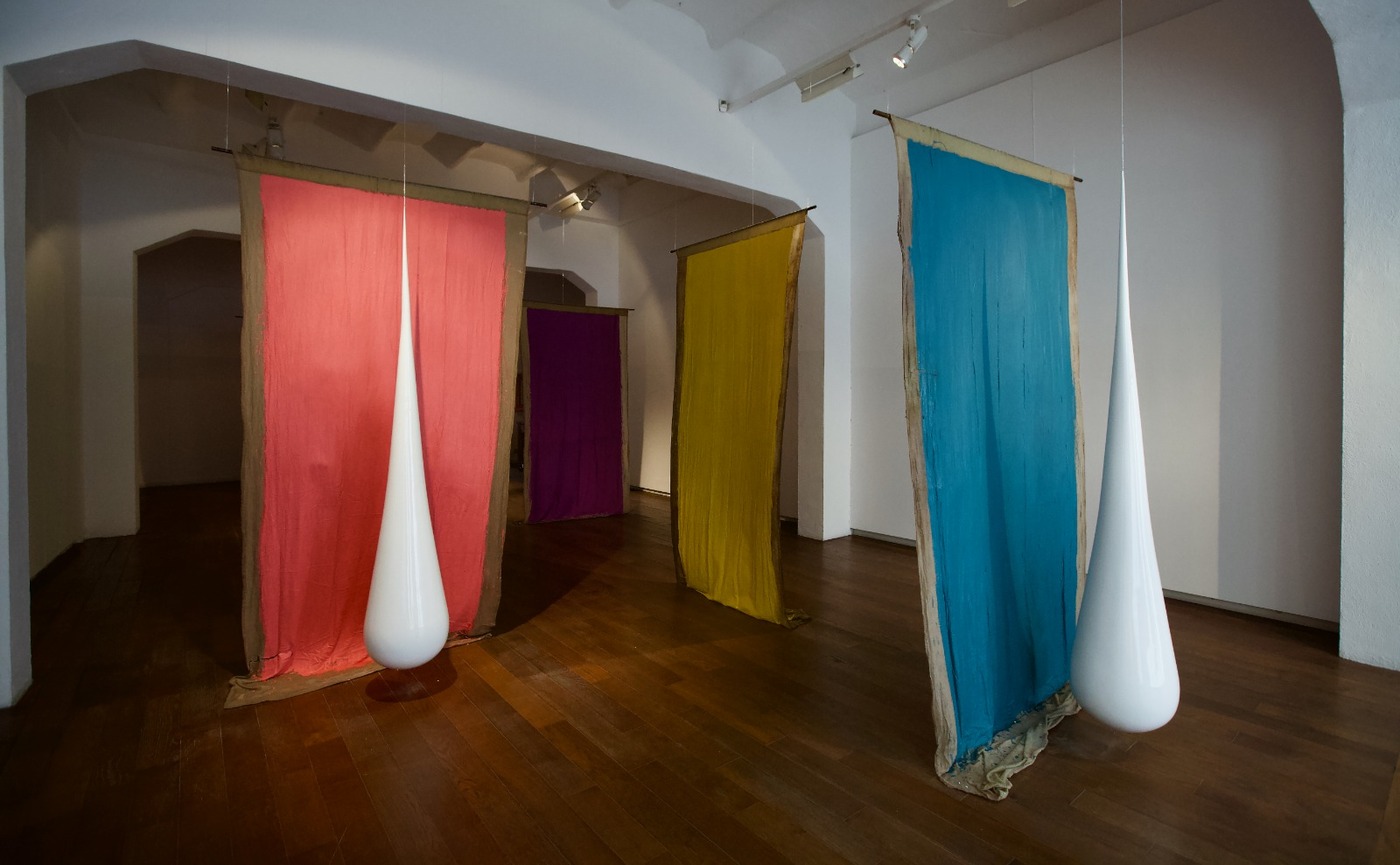
L’actual proposta de Santiago Villanueva té no només un inesperat caràcter escenogràfic, sinó què representa la primera inclusió de materials dúctils -teles de cotó banyades amb resina i pintades per ambdues cares- que creen noves sensacions visuals i, sobretot, que reclamen la intervenció de l’espectador com activador de l’espai. És a dir, sense renunciar al seu passat ni deixar de banda el que l’ha situat com un dels escultors més rigorosos i contundents dins la seva línia, Villanueva s’ha apropat aquest cop als artistes ambientalistes que treballaven amb la llum, amb una diferència important. L’artista utilitza el concepte d’il·luminació barroca, concentrant l’atenció damunt cada peça d’aquest nou tàndem que és ara la pintura i l’escultura, multiplicant els efectes cromàtics al combinar-se entre sí cadascuna de les inflexions de les set unitats escultòriques.

Ja als seus inicis apreciàvem lo important que era per l’artista atreure la mirada dels seus espectadors, potenciar la seva percepció, convidar-lo a apropar-se a mirar de prop, tocar i sentir la bellesa subtil de les seves formulacions de caire naturalista. Era una intensa sensació tocar allò que l’ull no arribava a veure: la càlida consistència i definició de les peces. Algunes ens feien recordar aquella màgica imatge captada per la càmera fotogràfica de Harold Edgerton al 1936 de l’instant en què una gota de llet, encara sencera, queia abans d’arribar a desfer-se.

Si l’escultura de Villanueva ja representava aleshores la conjunció de factors formals en principi, antagònics, és a dir, la forma estable de la duració i l’empremta del gest imperfecte de la mà humana així com el moviment natural de les coses, ara ha encetat una nova via escultòrica que suposa traspassar un arriscat llindar. Un repte del que, avencem, n’ha sortit reforçat. És a dir, en aquesta exposició s’ha confirmat la consistència del procés gradual d’expansió dels límits de l’escultura de Villanueva i, un cop més i de forma original, el seu projecte insisteix en la singular dialèctica entre lo humà i lo orgànic, entre lo ingràvid i el pesant, entre la bellesa del disseny i la emoció del color.
És així com veiem en les rígides escultures de cotó de “Set” el resultat d’un procés d’interiorització en el qual pesa l’influx d’aquelles peces de resina vermella que -a mode de cortines- penjaven damunt el Pati del Casal Solleric l’any 2015 i que, en un interessant viatge de la memòria, ja ens conduïen a l’estudi i posterior escultura de Magritte de 1960 titulada “La Gioconda”.

Ara està clar com i perquè Santiago Villanueva ha sabut portar les seves escultures a un diàleg amb la pintura i als efectes ambientals del color: gràcies al seu coneixement de les possibilitats dialèctiques de la instal·lació escultòrica. Aquest valent canvi de perspectiva confirma l’artista com innovador d’una genealogia de mestres de la forma dins l’espai, en la que apareixen també artistes com Jannis Kounellis o Anish Kapoor. Seria així la seva, una visió actualitzada d’aquelles investigacions formals que varen arrencar a partir del llegat de l’escultura de peça única (de vegades també dites “de peanya”) per arribar al concepte d’integració de les formes dins l’espai de l’escultura expandida.
Tanmateix, el viatge cap a l’espai escenogràfic de l’obra de Villanueva podia haver començat quan va signar “Resistència”, aquella magnífica instal·lació de tubs blancs que penjaven del sostre de l’Espai Born del Casal Solleric, que ens permetia establir certs vincles formals i conceptuals entre el seu treball i el d’altres tan assenyalats com el Robert Morris de la instal·lació a la Galeria Leo Castelli de 1967 -integrada per peces de feltre que caient aleatòriament- o amb l’artista pionera en l’ús de materials industrials com el làtex, la fibra de vidre i el plàstic, Eva Hesse -en particular amb les obres de “Contingent”, projecte expositiu que va acollir la National Gallery d’Austràlia entre 1968-69-.

A “Set” trobem, doncs, el Villanueva dels darrers anys i, alhora, un nou començament dins la trajectòria d’un artista innovador que ha superat els seus límits, creant un espai escenografic d’encontre en el qual les seves escultures actuen com a personatges d’un simbòlic diàleg de forces. Una trobada experimental protagonitzada per les seves tradicionals, consistents i duradores escultures de resina blanca i la nova matèria orgànica que introdueix el sentit tàctil de la pintura i els colors brillants que ara omplen i transformen la vibració de l’espai que es reflecteix damunt les seves blanques escultures. Podríem dir que és aquest una mena de coratjós “triple salt mortal” que Villanueva s’ha decidit a realitzar per tal de donar un pas endavant en la seva personal concepció del què és l’escultura avui.
Així es confirma que Santiago Villanueva és un artista rigorós i coherent que, sent coneixedor de les diferents tradicions escultòriques europea i nord-americana -principalment en l’àmbit del naturalisme geomètric-, segueix transitant lliurement pel camí que ha triat per proposa amb la seva obra una síntesi personalíssima de les conquestes dels mestres del segle XX. Que el cor de l’artista batega igualment amb Moore i amb Kapoor. Que li plau trobar la seva inspiració en la Història de l’Art i en les lliçons de la gran pintura. Que no necessita negar la representació realista de la natura ni les formulacions dels elements materials del món. I, sobre tot, que aposta fermament per trobar el seu propi lloc en aquell camí que posa l’accent en la forta presència de l’escultura a l’espai, per incorporar els nous recursos i l’esperit del seu temps i ocupar un lloc privilegiat en aquell llegat al qual ell mateix ja pertany.
ENGLISH TRANSLATION
SANTIAGO VILLANUEVA: EXPANDING AN SCULPTURAL LEGACY
Between February and May in 2015 the Casal Solleric in Palma hosted a single exhibition of Santiago Villanueva (Madrid, 1964) that later travel to the Kühne Logistics University in Hamburg and to the Today Art Museum in Beijing. The splendid combination of installations and sculptural sets that were included in this project was a highlight in the trajectory of the artist and architect that decisively contributed to the internalization of his work. That amazing proposal already showed how Villanueva understood sculpture: as a universal dialogue with the tradition that he adopted. In my curatorial text for the catalogue, entitled “Magritte’s curtain or the fascinating entity of the visible in Santiago Villanueva’s sculptures”, I outlined the artist’s objectives: “a search for original solutions to renew the contemporary sculptural tradition of naturalistic and geometric roots (…) that has led him to that intelligent synthesis between the geometric -intellectual- and the organic and human -sensitive- reflected in his sculptures”.
Seven years later we may observe how the inspiration and ideas already contained in that exhibition have been exemplarily developed in the artist’s new projects. Among others, his exhibition “Probably yes” at Xavier Fiol in 2017, consisted in a unique installation integrated by a diagonal of corten steel painted black block-like sculptures topped with "ellipsoid" shapes of white resin that broke the geometric perfection of the whole with its random movement, introducing the performance of chance. It’s this same drive what led him to include human gestures as a nuance to the formal perfection of his pieces, humanizing pure sculptural forms. And this is what he has accomplished again in his current exhibition that, under the titled of “Set”, represents a turning point of his work.
Santiago Villanueva current proposal offers not only a new, unexpected, scenographic character, but it also represents his first use of ductile materials - cotton fabrics coated with resin and painted on both sides - that create new visual sensations and, above all, call for intervention of the viewer as activator of the space. In order words, without giving up of his past or changing his artistic personality, Villanueva has come closer to the environmental artists that worked with light. The difference is that the artist uses the Baroque concept of direct illumination over the pieces to accentuate the different vibration of this new tandem that is now painting and sculpture, multiplying the chromatic effects of the set as the reflection on each piece sparks over the next one and on all the group.
Since the beginnings of his career, Santiago Villanueva show how important was for him to attract his spectators gaze and intensify their perception, feeling the necessity to approach and touch the fine and subtle beauty of his naturalistic-like sculptures. It was an intense sensation discovering with hands what eyes could not feel: the perfect consistency of the artist’s sculptures. In fact, some of these works made us remember of the magic definition of the famous photography by Harold Edgerton, in 1936, of the instant when a milk drop falling still showed its perfect shape.
These first sculptures by Villanueva already exemplified the combination of formal factors in principle antagonistic, that is, the stability of duration and the random, ephemeral, marks of human hands and of the natural movement of objects. In an interesting expansion of his own artistic vocabulary, he has now accomplished an unprecedent change of perspective, trespassing a risky threshold. A challenge that, let’s advance, he has achieved. In other words, his last exhibition has confirmed the consistency of the gradual process of expansion of Villanueva’s sculptures limits.
Again, and in an original way, his work insists in the singular dialectics between human and organic, between weightless and heavy, between the beauty of design and the emotion of colour. For instance, we may consider his cotton-like rigid sculptures of “Set” the visible result of an inner process of reflection that started with the installation of the garnet resin curtain-like sculptures that hung over the courtyard of Casal Solleric in 2015, which, in an interesting travel of memory, led us to the Magritte’s drawings and sculptures of 1960 entitled “The Gioconda”.
It’s now clear why and how Santiago Villanueva has been able to take his sculptures to a dialogue with painting and the environmental effects of colour: thanks to his knowledge of the dialectic possibilities of sculptural installation. This courageous new turn, means the confirmation of the artist as innovator of a great genealogy of masters of the form in space, where we may find the names of artists such as Jannis Kounellis or Anish Kapoor. Thus, the artist’s contribution is an actualized approach of the formals research that started from the “pièce unique” tradition (also said sculpture of pedestal) to reach the integrative spatial concept of the expanded sculpture field.
The travel to the scenographic space of Villanueva’s artistic programme may have started when he signed “Resistance”. This astonishing installation of white tubes hanging from the ceiling had some formal and conceptual links with other precedent outstanding artist’s works. For instance, with the installation of felt pieces randomly falling and laying from the wall to the floor of Robert Morris at Leo Castelli Gallery in 1967. Or with the open sculptural practices of Eva Hesse, the pioneering artist in the use of industrial materials such as latex, glass fibre or plastic, particularly with her works included at “Contingent”, an exhibiting project hosted by the National Gallery of Australia in 1968-69.
In sum, “Set” represents Villanueva’s artistic program of the last years and, at the same time, the fresh start of an innovative artist that has overcome his limits by creating another symbolic field for his sculptures, now interpreting a dialogue of forces. An experimental encounter starred by his traditional, consistent and durable white resin-like sculptures and the new organic matter that introduces the tactile sense of painting and the sparkling colors that fill and transform the vibration of the space. We could say that this is a kind of courageous "triple jump" made by the artist to take a step forward in his personal conception of what sculpture is today.
Today we may confirm that Santiago Villanueva is a rigorous and coherent artist who, being familiar with the different European and Nord-American sculptural traditions -mainly in the field of naturalistic geometry-, continues to freely travel along the path he has chosen to offer a very personal synthesis of the achievements of the 20th and 21th centuries sculpture. That the artist’s heart beats equally with Moore and Kapoor. That he may find his inspiration both in everyday objects or in the History of the Arts and in painting’s lessons. That he doesn’t need to deny the realistic representation of nature to feel close to abstraction’s sensitivity. And, above all, that he’s firmly committed in finding his own place in this wide path that believes in the strong presence of sculpture in the space and in incorporating the spirit and new resources and the spirit of its own time. And this is how Santiago Villanueva is now occupying a privileged place within a legacy to which he himself already belongs.