L’obra de Sandra Vásquez de la Horra (Viña del Mar, Xile, 1967) està impregnada per la idea del nomadisme i el viatge, per la migració i fusió de creences i tradicions culturals que resulta de les relacions comercials, els moviments de persones i, entre d’altres, per les conquestes de “noves terres”. L’artista és una investigadora meticulosa i ben informada que centra la seva profunda mirada en altres sabers simbòlics, en tradicions submergides o en l’hermetisme alquímic d’herències arcanes de ritus i mites on la màgia, la vida quotidiana i la religió es donen la mà. Aquestes característiques proporcionen un caràcter diferencial i únic a la seva obra, que se situa en la perifèria estètica i argumental de l'art actual per assenyalar el valor d'altres fons de coneixement i pràctica de vida. Una cosmologia del cos humà i les seves mutacions, transformacions i hibridacions amb la natura o amb animals simbòlics dóna lloc a gran part dels seus celebrats dibuixos de grafit. Hipnòtics, al·lucinats personatges, peces fragmentàries combinades com un retaule sinuós damunt el mur i d'ençà de uns anys la irrupció del color i l'escultura, amb les "cases" i les obres de paper tridimensional, tot el que crea l'artista posseeix tals dosis d'autenticitat i aquest exòtic misticisme pràcticament expulsat de l'art occidental que ha conquerit el col·leccionisme i la crítica internacional.
“L’ULL INTERIOR”. Galeria Kewenig, Palma: Fins al 14 de Gener de 2023
“AURA”. Galeria Senda, Barcelona. Fins al 20 de novembre de 2022

Amb la seva fèrtil imaginació i els recursos adients, l’artista interpreta amb el seu estil inconfusible repertoris iconogràfics populars, contes i llegendes del seu país natal, Xile, així com narracions miraculoses i coneixements hermètics escrits o transmesos oralment de generació en generació entre els pobles indígenes. El sincretisme del Cristianisme amb la religió Yoruba -exportada pels esclaus africans- ocupa un lloc important als seus dibuixos, que tenen sempre un component fantasmagòric i misteriós, que poden ser irreverents i xocants, amb un sentit de l’humor molt particular i que, de vegades inclouen textos.

Emperò, si bé l’obra de l’artista recupera i dóna forma a imaginaris afro-americans o mitologies indígenes ameríndies, mostra també punts de contacte amb l’art i la cultura occidental. A més dels “Caprichos” de Goya i del dibuix d’Odilon Redon, la seva obra connecta amb la pintura surrealista de Remedios Varo, Eleonora Carrington o Max Ernst. Amb formació en Disseny Gràfic i un Doctorat en Belles Arts a Alemanya, on seguí cursos amb Jannis Kounellis, els seus interessos abasten molt més, com escriu Jonas Storsve en un text dedicat a l’obra de l’artista: “De fet, si aquest art erudit i sofisticat té les seves arrels en els orígens sud-americans, també es nodreix d'una cultura visual rica i variada i d'un coneixement exhaustiu de la literatura, la filosofia i antropologia europea i sud-americana".
"Alquímia fantàstica", fou el títol del primer catàleg que publicà la Galeria Kewenig a ran de la seva primera mostra amb l'artista. Paga la pena fullejar aquest compendi de dibuixos per conèixer millor l'obra de Sandra Vàsques de la Horra i sorprendre'ns amb la seva immensa capacitat de transformació de la realitat. A mig camí entre la fantasia i el deliri, els seus dibuixos groguencs i de textura engruixada per la cera tenen una fascinant aparença envellida -com de restes d'una troballa arqueològica- i on ni les persones, ni la natura, ni els entorns o les situacions se sotmetent a les regles de la lògica. Personatges híbrids d'humanitat i natura, monstres i criatures caricaturesques, verges i dimonis, éssers tendres i de vegades repel·lents, desvergonyits, enjogassats o exultants de sexualitat, formen part d'un ample repertori d'estranyes criatures que ens guien cap a un viatge de descobriment dels imaginaris dels pobles indígenes, on el concepte de temps ha quedat totalment esborrat.


En un moment de gran maduresa creativa i després d’haver obtingut un unànime reconeixement internacional al seu treball, Sandra Vàsques de la Horra fou recentment distingida amb la concessió del Premi Hans Theo Richter de Dibuix i Gràfica de la Saxon Academy of Arts and the Hildegard and Hans Theo Richter Foundation l’any 2021. Aquest prestigiós guardó reconeix que “El seu món poètic d'imatges totalment independent i profundament commovedor neix de l'experiència personal. Està arrelada en les tradicions i mites dels seus orígens xilens i també es basa en fonts de la història cultural europea”.

Tancada fa pocs dies la seva mostra “Somnis lúcids” a la Galeria Vandana Pinel de París, tres exposicions obertes actualment a Venècia, Palma i Barcelona ens ofereixen l’escenari propici per revisar els treballs actuals de Sandra Vásques de la Horra. Oberta fins a final de novembre, “The Milk of Dreams”, títol de la instal·lació de l’artista a l’Arsenale dins el marc de la 59 edició de la Bienal de Venècia, pren el seu nom d’un llibre on Eleonora Carrignton (1917-2011) descrigué un món màgic on tot pot canviar gràcies a la imaginació. Vàsques de la Horra enceta amb aquesta artista britànica arrelada a Mèxic, on morí, un diàleg íntim a través d’un sinuós univers iconogràfic, visual i textual, pictòric i escultòric basat en experiències “límit” i titulat “Las cordilleras encontradas”, un projecte que té molt a veure amb les mostres paral·leles de l’artista a la Galeria Senda de Barcelona i Kewenig de Palma.

“Aura” és el títol que unifica el conjunt d’obres que Vásques de la Horra presenta a la Galeria Senda de Barcelona, que parteix dels principis de la Teosofia per explorar el vincle entre l’aura i la naturalesa humana. En aquesta exposició podem observar tant la proliferació de suports, formats i tècniques i, sobretot, la riquesa i versatilitat del seu llenguatge, recursos amb les quals l’artista ha diversificat la seva producció, on sempre té un gran protagonisme del cós humà, al que confereix diferents funcions i simbolismes. Per exemple, els cossos de vegades només son caps, reforçant el sentit espiritual, i també poden ser “territoris”, “ens geogràfics dotats de laberints, paisatges i serralades” que es converteixen en mapes d’experiència i vida.
El fet unificador del conjunt és la reflexió de l’artista sobre les diferents dimensions del cos -física i espiritual, mental i emocional-, convertint-lo en una força receptora-emissora d’energia en comunió amb l’univers a través dels xacres, aquells set “llindars” que connecten el món físic amb l’espiritual. A més d’un mural de dibuixos de petit format i una “casa” en blanc i negre, és molt notable la inclusió d’un parell de dibuixos de gran format protagonitzats per dones voluptuoses i de críptica anatomia.
És el cas de l’imponent dibuix a color titulat “L’alliberament del mite”, de 2022, que fa referència a la vagina dentada de les dones, un mite popular que estigmatitzava el sexe femení convertir-lo en quelcom perillós. Aquesta magnífica aquarel·la converteix el cap de la dona en la closca d’una ostra, mentre ocupa el centre del tòrax i el ventre un enorme i somrient com uns llavis sexe “dentat”. Un dels pits de la figura s’ha pintat amb els mateixos colors del sexe per accentuar la identitat femenina.

A més d’aquesta immersió en la Teosofia, hi ha en les obres presentades a la Galeria Senda un ressò de l’activisme crític envers el sistema dictatorial del país d’origen de l’artista, circumstància que dóna lloc a la seva mostra a la Galeria Kewenig de Palma.
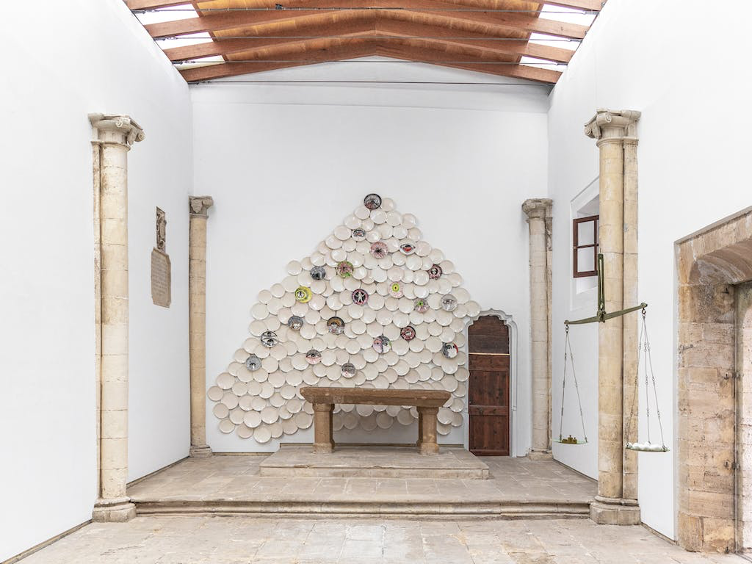
Sota el títol “Ull interior”, ens trobem aquí davant un dels projectes més singulars i innovadors del repertori de Sandra Vásques de la Horra, que continua desenvolupant la seva línia escultòrica i tridimensional amb un imponent mural ceràmic realitzat al taller mallorquí de Pere Coll a Pòrtol. Es tracta d’un conjunt de més de 200 plats blancs entre els quals sobresurten els 21 pintats a mà per l’artista en record i homenatge a les 21 persones que perderen la visió d’un o els dos ulls durant les revoltes xilenes contra les desigualtats socials que pateix el país andí durant la tardor del 2019. Una vindicació que l’artista du al territori de la religió Yoruba i als seus principis de justícia i equilibri que regeixen les relacions entre els humans i els Orishas, les deïtats que governen els diversos aspectes del món. Cal assenyalar que l’artista va viure un temps a Cuba per estudiar profundament aquesta religió que comparteix amb el Budisme i l’Hinduisme la seva creença en el karma i la reencarnació.


Dedicat a Obatalá, manifestació del deu suprem de la religió Yoruba que és descrit com un vell molt blanc de pell, molt intel·ligent i misericordiós, i que regeix sobre els caps dels humans, aquest singular “mant” blanc s’ubica al que fora l’altar de l’antic Oratori de Sant Feliu, des-d’on arriben aquestes colpidores imatges de dolor, dels ulls en llàgrimes, de les calaveres, dels esquits vermells que recorden la sang i les figures humanes trastocades pel patiment. La casualitat ha volgut que el número 21 representa a Eleuá, l’Orisha guerrer i amo del destí que obre o tanca els camins dels humans.
Vista instal·lació amb mural ceràmic i escultura. “L’Ull interior”, 2022. A la part central de la imatge: “Aché”, escultura de ferro i ceràmica. Galeria Kewenig.
Complementen aquesta bellíssima obra ceràmica de la Capella altres escultures, com la balança on trobem 21 peces dedicada a Aché, l’Orisha de l’equilibri, l’ordre i la justícia. A més, trobem la petita “Pombagira”, manifestació de María Padilla i la Carmen de Bizet, que representa la feminitat tentadora, un pot blanc de ceràmica i una campaneta per cridar a Obatalá. Per la seva part, a l’espai annex a la Capella, s’exposa un conjunt de dibuixos de grafit i un curiós mural de dibuixos automàtics d’aquells que es fan mentre parlem per telèfon.

Finalment, i per cloure aquest repàs per les diverses propostes que ens mostren una Sandra Vásques de la Horra compromesa amb els valors de l’espiritualitat, el misticisme i la necessitat d’empatia en un temps de greus incerteses polítiques i socials, podem afirmar l’oportunitat de la seva evocació dels profunds significats d’aquests coneixements arcans encara vius i presents en un temps de globalitzadora homogeneïtat als quals fa un lloc al seu treball.
A més, tot el que hem vist ens obliga a pensar en la possible inversió d’aquella actitud condescendent envers ”l’exotisme” dels “bons salvatges” i el menyspreu que va patir el patrimoni i els sabers immaterials d’aquells pobles que encara vivien en harmonia amb la natura per part dels intel·lectuals del segle passat. La realitat és que som potser nosaltres, els cultivats i civilitzats habitants d’Occident els qui ens hem allunyat tant de la natura i dels seus secrets que -com recorda Jacinto Lageira- correm el perill de ser uns “mals salvatges” i veure’ns obligats a emprendre un viatge de retorn als principis d’una humanitat que sàpiga conviure harmònicament amb la natura i els altres éssers amb qui compartim el planeta.
ENGLISH TRANSLATION
SANDRA VÁSQUES DE LA HORRA: OTHER SOURCES OF LIFE AND KNOWLEDGE
Born in Viña del Mar, Chile, in 1967, all of Sandra Vásques de la Horra works are permeated by the idea of nomadism and travel, by the migration and fusion of beliefs and cultural traditions which bring with commercial exchanges, people transfers and the conquest of new lands. The artist is a meticulous and wise researcher that centres her interest in other symbolic knowledges, in submerged traditions or in the hermetic legacy of arcane rites where alchemy, magic, daily life and religion meet. While these characteristics place her proposal in an aesthetic and discursive periphery of current art, it gives to her creations a unique capacity of highlighting the great value of other sources of knowledge and practice of life. The best examples are her celebrated drawings of graphite bathed in wax, which draw a rich cosmology of the human body and its mutations, transformations and hybridizations with natural elements or symbolic animals. Hypnotic and hallucinated characters live in the individual works which she combines on the wall in a winding line, as well as on the “houses” and paper-made sculptures and big coloured drawings. Everything the artist creates possesses that touch of authenticity and exotic mysticism -practically absent in contemporary art- that has conquered international collectors and criticism.
Thanks to a fertile imagination, the appropriate resources and her unmistakable style, Sandra Vásques de la Horra interprets popular iconographic repertoires, tales and legends of her native country, Chile, as well as miraculous narratives, written hermetic knowledge or orally transmitted from generation to generation among indigenous peoples. The syncretism of Christianism with the Yoruba religion -brought by African slaves- play an important role in her drawings, which may have a phantasmagorical and mysterious air, be irreverent, shocking or humorous and have added texts.
However, while the artist recovers and gives a new birth to Afro-American imaginaries or Amerindian indigenous mythologies, her work is also influenced by Western Culture. Besides Goya’s “Caprices” and Odilon Redon’s drawings, we may connect her style with the Surrealist compositions of Remedios Varo, Eleonora Carrington or Max Ernst. With an Academic Degree in Graphic Design and a Doctorate in Fine Arts from a University in Germany (where she followed courses with Jannis Kounellis) her interests are very diverse. Jonas Storsve observed this in a text dedicated to the artist: "Indeed, if this erudite and sophisticated art has its roots in South American origins, it is also nourished by a rich and varied visual culture and of a deep knowledge of European and South American literature, philosophy and anthropology".
“Fantastic alchemy” was the tittle of the first catalogue published by Kewenig Gallery on the occasion of their first exhibition with the artist. It’s worth to watch at this summary of drawings to better discover Sandra Vásques de la Horra work and be surprised by her immense capacity of transformation of reality. Half way between phantasy and delirium, her yellowish and richly textured waxed drawings have a fascinating aged appearance -similar to archeological remains- where neither persons, nature or environments seem to follow the rules of logic. Hybrids of humanity and nature, monsters and caricaturized creatures, virgins and demons, tender and sometimes repulsive beings, shameless, playful or exultant with sexuality, are part of a wide repertoire of strange characters that guide us towards a journey of discovery of the imaginaries of the indigenous peoples and where the concept of time has been completely erased.
In a moment of great creative maturity and having obtained unanimous international appreciation to her work, Sandra Vásques de la Horra was recently honoured with the 2021 Prize Hans Theo Richter of Drawing and Graphic of the Saxon Academy of Arts and the Hildegard and Hans Theo Richter Foundation. This prestigious award recognized: “Her totally independent and deeply moving poetic world of images is born from her personal experience. It is rooted in the traditions and myths of her Chilean origins and is also based on sources from European cultural history”.
Having closed just a few weeks ago her show “Lucid Dreams” at Vandana Pinel Gallery in Paris, three other exhibitions currently opened in Venice, Barcelona and Palma, offer us the opportunity to revise the latest works of Sandra Vásques de la Horra. Open until the end of November, “The Milk of Dreams” is the title of her installation at the Arsenale, included in the 59th edition of Venice Biennale, that refers to a book by Eleonora Carrington (1917-2011) describing a magic world where everything may change thanks to imagination. Thus, Vásques de la Horra visual proposal opens a dialogue with the British artist that lived and died in Mexico, developing a sensual iconographic, textual, pictorial and sculptural universe based on her own limit experiences. She has entitled a group of works “Las cordilleras encontradas” (The found mountain ranges), which have a lot to do with her parallel exhibitions at Senda and Kewenig Galleries from Barcelona and Palma.
“Aura” is the title that unifies the set of works that Vásques de la Horra presents at Senda Gallery, which has been inspired by the principles of Theosophy, with the aim to explore the links between human nature and the aura. This exhibition exemplifies both the proliferation of supports, formats and techniques and, over all, the richness and versatility of her visual language, which she has achieved to diversify. As usual, the great protagonist is the human body, that has acquired different functions and symbolisms. For instance, bodies are sometimes only heads, reinforcing the spiritual sense, but they may also be “territories”, “geographic entities that hold labyrinths, landscapes and mountain ranges” which become maps of experience and life.
The unifying fact of the whole set is the artist’s reflection on the different dimensions of the body -physical and spiritual, mental and emotional- turning it into a receiving-emitting force of energy in communion with the universe through the chakras, the seven "thresholds" that connect the physical world with the spiritual. In addition to a mural of small-format drawings and a black-and-white “house”, a couple of large-format drawings featuring voluptuous women with cryptic anatomy is very notable.
Among other example, the impressive big color drawing entitled “The liberation of the myth” (2022) refer to the popular myth of the jagged vagina, which stigmatized the female sex, turning it into something dangerous. This magnificent watercolor transforms the woman's head into the shell of an oyster, while the center of the chest and belly is occupied by a huge and smiling "toothed" sex lips. One breast has been painted with the same colors as the sex to accentuate the female seductive identity.
In addition to this immersion in Theosophy, there is an echo of the critical activism towards the dictatorial system of the artist's country of origin in the works showed in Senda Gallery, a circumstance that gives rise to her show in Kewenig Gallery.
Under the title “The inner eye”, we are faced in front one of the most singular and innovative projects of Sandra Vásques de la Horra, which continues developing her sculptural and tridimensional line of work with an impressive ceramic mural realized at Pere Coll workshop in Pòrtol (Mallorca). The work consists of a set of more than 200 white dishes, with 21 of them hand-painted by the artist in memory and tribute to the 21 persons who lost the sight of one or both eyes during the Chilean revolts against social inequalities suffered by the Andean country during the Autumn of 2019. Vásques de la Horra brings her vindication to the Yoruba religion and its principles of justice and balance that govern the relationships between humans and the Orishas, the deities that rule the various aspects of the world. It should be noted that the artist lived for some time in Cuba to deeply study this religion which shares with Buddhism and Hinduism its belief in karma and reincarnation.
The mural is dedicated to Obatalá the intelligent and merciful manifestation of the supreme God of the Yoruba religion Olodumare. Obatalá is described as an old man of very white skin, being the God that rules the human heads. In correspondence, the piece is a precious white “mantle” hanged where previously was the altar of the Sant Feliu Oratory. From this significative place, the striking images of human figures distorted by sufferance move us to piety. Coincidentally, 21 is the number that represents Eleua, the warrior Orisha and master of destinies that opens or closes the paths of humans.
There are a few more sculptures that complete the presentation of this beautiful and touching ceramic mural, such as the weighing scale with 21 ceramic “eyes” dedicated to Aché, the Orisha of equilibrium, order and justice. In addition, there is a small "Pombagira", a manifestation of María Padilla and Bizet's Carmen, which represents tempting femineity and a white ceramic jar and a bell to call Obatalá. As a complement, there are other works of Vásques de la Horra on display at the gallery space next to the Chapel: a set of graphite drawings, paper tridimensional sculptures and automatic drawings like those made while we talk on the phone.
The overview of these proposals has showed us not only the deep meanings of arcane knowledges, but also the activism and the engagement of Sandra Vásques de la Horra work with values of spirituality, mysticism and the need of empathy in a time of globalizing homogeneity and serious political and social uncertainty.
Moreover, everything we have seen forces us to think about the possible reversal of that condescending attitude towards the “exotism” of the “good savages” and the contempt suffered by the heritage and the immaterial heritage of those peoples who still lived in harmony with nature. The reality is that perhaps we are, the cultured and civilized inhabitants of the West, who have distanced ourselves so much from nature and its secrets that -as Jacinto Lageira remembers- we are in danger of being considered the new “bad savages” forced to undertake a journey back to the principles of a humanity that knows how to live harmoniously with nature and the other beings with whom we share the planet.