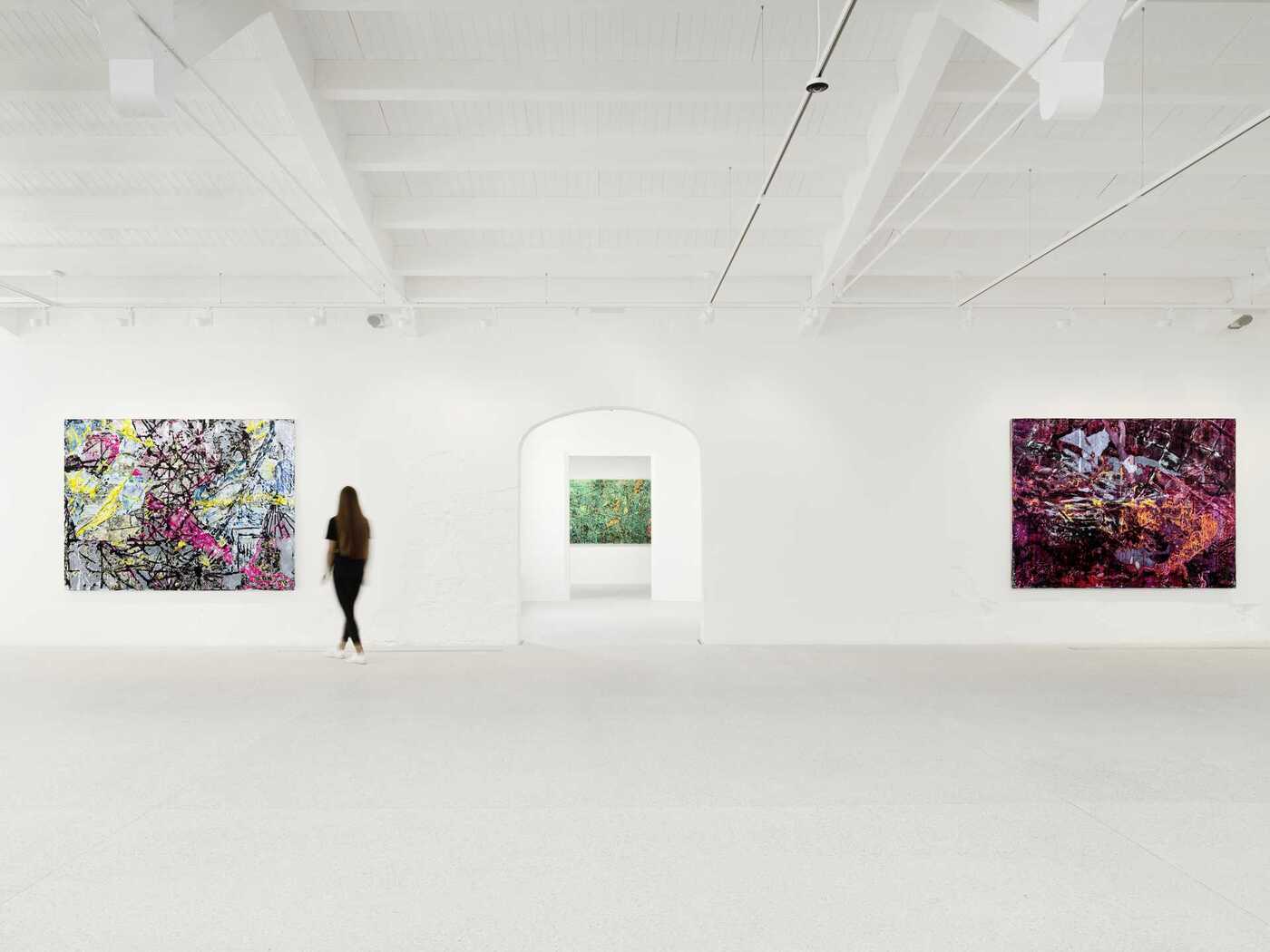
Few weeks before Mark Bradford was born, on November, 20th, 1961, the Berlin Wall just began its construction. It was the starting point of a decade of revolt against American interventionism in Vietnam War and the split of Europe into political blocs of power, that encouraged a whole generation wishing to change world to take peace as their slogan.
Meanwhile Europe was still burying the remains of the war under their new buildings, artists such as German Wolf Vostell started in 1954 organizing his dé-collage happenings at Paris streets, inviting the public to cultivate their critical spirit breaking the publicity imagery that, among other messages, promoted the goodness of the American way of life. From 1961, the Noveau Realisme artists around art critic Pièrre Restany applied this expressive method to their painting-like artworks.

Sixty years after, we find in Mark Bradford’s work not only the inversion of that artistic technique that started by destroying posters (because he collects and keeps them), but also the echo of that subversive attitude that gave to the remains of society both symbolic values and aesthetic qualities. Bradford, that spent years working at her mother coiffeur’s salon and experienced Los Angeles hard night-life, started his artistic career strongly influenced by those years. Soon he made his work an engagement against all forms of violence and oppression, that years later draw him to create, together with activist Allan di Castro and philanthropist and art collector Eileen Harris Norton, the Art and Practice Foundation. Considered as an inquisitive “excavator” of de “world detritus”, the artist was soon widely appreciated for his impressive abstract-expressionist-collage-like paintings made with a whole amalgam of paper and useless remains. In 2017, Bradford represented the US at Venice Biennale with a site-specific project entitled “Tomorrow is another day”, that gathered together a group of paintings and the sculpture-like enormous “Medusa” installation, that hanged from the ceiling and aimed to be a protest against women abuse. Last year, the Texas’ Modern Art Museum Forth Worth hosted Bradford’s “End papers” exhibition, integrated by 35 paintings where the simple papers used for coiffeur purposes were the main collage material, the same that he used when paying his personal homage to American painter Agnès Martin.
Same as Mark Bradford’s visual narrations artistically transform his reality, his experiences and interests, his purposedly conceived exhibition for the opening of Hauser & Wirth Menorca is also linked to the combination of old wasted papers and all sort of remains that are added to the artist structured and visually complex compositions. “Masses and Movements”, title of the project, is based on a map of 1507, the Waldseemüller, where it appears the word America for the first time. This antique treasure of world cartography has inspired the amazing group of paintings, sculptures and multimedia installations that show formal distortions of the continent’s lines and the dynamism of parallel and meridian curved lines, as well as the vibrant chromatic contrasts or the typical appearance of small visual registers. These works, totally realized around the idea of cartography, compose an elaborated visual reflection that places at the core of its narration the current world issues and the social, economic and ecologic challenges that fly over mankind future horizons.
Despite Mark Bradford’s reproductions tent to be very good, his work needs of closeness to reveal all its techniques and qualities. There are made of layers and layers of materials, as those that carry out rivers when running to a bay, or same as it happens with old cities, such as Rome, that are grown over many overlapped layers. Mark Bradford says that Mahon port and its history, as well as Menorcan landscape have been very present when creating this last project of him, that we perceive powerful, vibrant, fascinating in its richness of solutions.

There is not one but many planets and many epochs -past and future, historical and geological- in this memory-like-invented maps in which Mark Bradford testifies his emotion for the bustle of life in the streets or his devotion to poetic silence of matter. This is how he tells us about ice and fire, water and stones, the colors of flowers and the blowing of the wind, aged textures and shapes transformed into new shapes. While many of his works visually vibrate singularly and differently, we should also point out the artist’ mastery in achieving a dual appearance to some of them, such as the impressive grey diptych in which we may guess both the stillness that follows an apocalypse or, perhaps, the silent formation of earth masses, when everything was matter and light had not been yet made.
And so, we enjoy looking at the totally different vision of the dynamic movement that, like a windstorm, seems to sweep away the surface of an entire continent. Soon after, we discover the force of the earth as its entrails seem to be shed invading that fiery red paint, to finally flood our eyes with the fresh greenery of that pictorial composition that looks like a garden. And after having step back to observe a group of pieces, we get close up enough to discover the many hidden little compositions that, same to “the painting within the painting”, splash out the surfaces of these works that seem to be made of the remains of a “shipwreck” of the extinct facts and scraps of life that we leaved behind.
Mark Bradford's paintings transcend labels, as does his set of sculptures, which are worth stopping and looking at in detail. Bradford says that maps are always abstract, like numbers, and that by 2020 people were obsessed with data and information. The artist also states that the nomenclatures are definitive and difficult to change, that is why, perhaps, he has erased the names in this set of earth globes where continents look like burnt skins and the oceans are black, a disturbing vision that questions us about the present and future of a planet which symbolically shrinks in each new piece of the installation.

There are no traces of life or greenery on these continents, no city names or evidence of national borders. What Mark Bradford means - "it has a lot to do with power" - and what we see in it may or may not be the same. Everything is big and small, relative and transformed in these maps of a planet that has its largest continental mass in Africa -the land of origin of Bradford’s ancestors. The island of Menorca, so small, is not even visible in these skins that look like cardboard (or maybe banana).

The artist, who is the best interpreter of his own work, does not play riddles with his art. Rather, he openly offers all its keys in his written interviews and recorded videos. Given the number of spaces available in this former 18th-century hospital converted into a center for contemporary art by the Hauser & Wirth family, Mark Bradford carried out a last intervention consisting on drawing maps of the world by emptying the contours of continents on a room walls. For this task he relied on Menorcan art students who filled the masses of earth with colors that were partly erased during the process.

Bradford reflected here on the painful fact of emigration, which forces people to leave everything behind, even memory. Realizing the importance of loss and the execrable business that feeds on the dreams of the desperate, is being aware of one of the bloodiest dramas of the present.
That’s why the artist closes the tour through this exhibition by offering visitors printed copies of the fraudulent advertisements that come out every day simulating to sell houses and give loans, the sea and the land being the background for its the texts. This is the last episode of that journey that we have made through the maps of a world that lives one of its most critical stages.

We are not surprised by the attraction of Mark Bradford for an old map and that, from the stimulus of this document, he wanted to reflect on this unattainable binomial that are the continents and the masses (of people, of things, of lands ...). He who lived his own myth of salvation through art, often looks to the past to find in heroic stories a meaning to his own challenges. A cartographer himself, Bradford has been able to make of his inner journey through memory a true testimony of empathy with his time and, inviting to others complicity, we have discovered in this American artist the nonconformist spirit of old Europe.