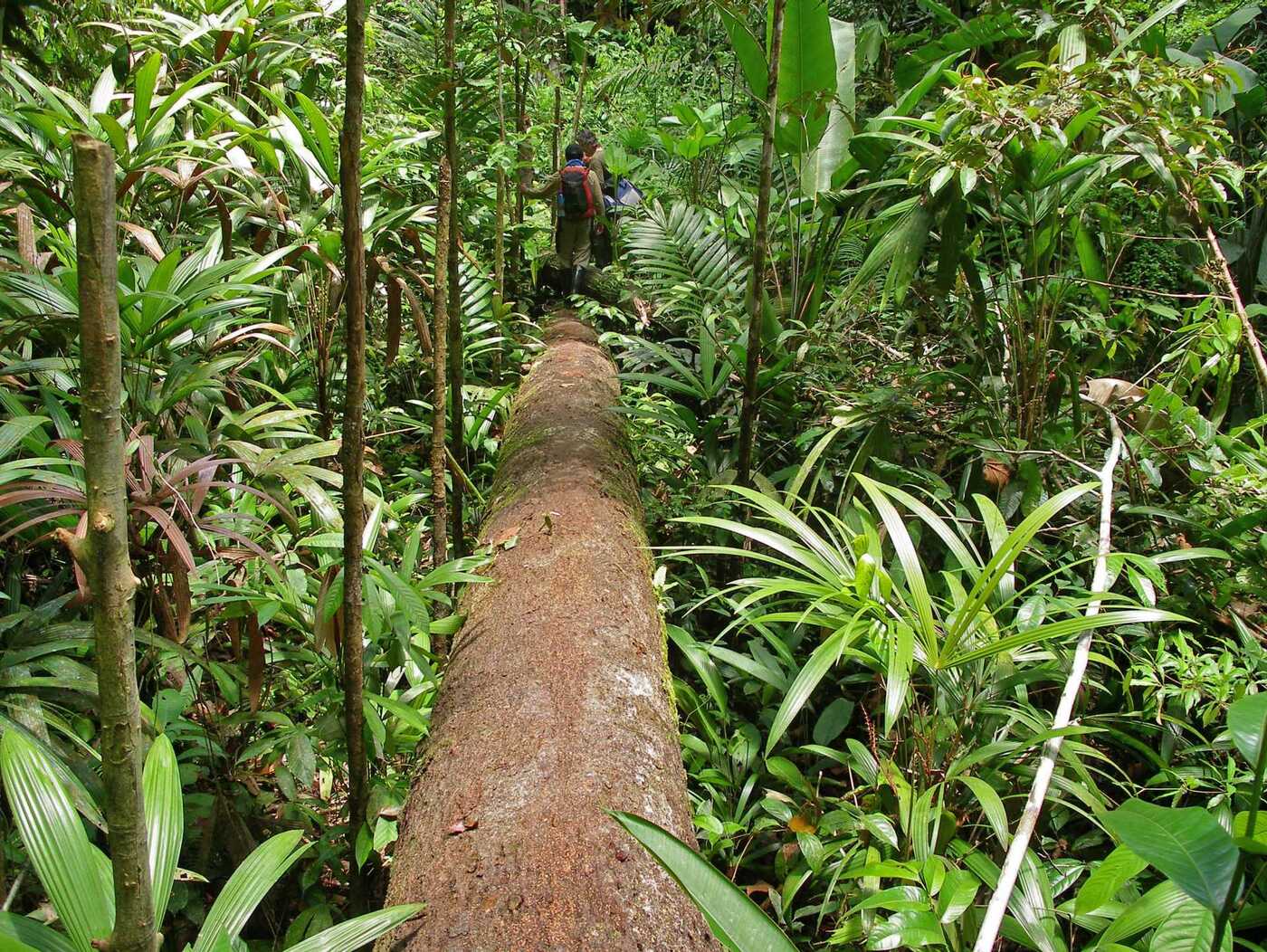
Tarapacá is about one hundred and eighty kilometres north of Leticia by land. The paved road ends at kilometre twenty-four. Despite the sign, it is not clear to the visitor whether, beyond, the road is accessible by some type of motor vehicle or if it can only be reached on foot. The local people call this road 'Los Quilómetros'.
Along the sides, as in many other Latin American rural areas, fences mark the boundaries of large private estates. Three kilometres after leaving the paved road to the east at kilometre eleven, the all-terrain vehicle cannot continue. Behind a traditional building for family, but also communal use; what they call here maloques, which are very common in the Amazon, with wooden walls and a roof of interwoven palm leaves, a banal-looking path gives access to the interior of the jungle. Heading north, following the border of the Colombian Amazon trapezium with Brazil, it leads to El Zafire, a biological research station at the Leticia headquarters of the National University of Colombia.

It takes a minimum of 8 hours to get there. Zafire means ‘white sand’ in the Huitoto language, and it is because the soil is white in colour, especially in the forest of thin trunks where the station is located. According to Ever, our guide, the predominant species in the area are clear evea, pachira and disimba. It is very hot inside this jungle. It’s like a kind of sauna, but it's even worse in the clearings because the sun evaporates the little water left in the tissues. The road is exhausting because this part of the Amazon, just a few tens of meters above sea level, is full of streams and, sometimes, mud. You find yourself in the depressions of the terrain, very undulating and rugged. There are about sixty of them until you reach El Zafire. When you have already lost track of what you are going through and you are convinced that there is still a long way to go, the maloca main station appears, half hidden by the vegetation. As you climb the steps to the last slope, other buildings welcome you. There is a dining room, bathrooms, a kitchen, a classroom with a blackboard where Ever promises to tell us the names of the plants in Huitoto, their language, an apartment for the visiting researcher and a storage depot, near the three solar panels that supply electricity to the very few electronic devices. There is also an awning where they spread their clothes and, in the direction of the forest on the opposite side of what has brought us here, two nurseries where they conduct research on plant stress.

They say that around here lurks a rattling pit viper that measures four meters long and half a palm wide, a terrifying viper that some claim to have seen and others claim that no one has ever seen. In the jungle, you end up seeing the things you feel from imagining them so much. When asking people here if they have ever seen a particular species, they don’t seem to distinguish between seeing and hearing. We only appreciated a clear distinction when we asked if they had ever come across it. In the jungle, when someone says they’ve seen something, you can’t be sure they’ve actually seen it. They may just have heard it. Hearing serves as evidence of reality as much as seeing.
[wpgmza id="1"]
Sud 04.00.182 – Oest 069:53.754 · 18.10 · 20/10/2009
Sons en Causa
Sons en Causa is a project of Orquestra del Caos based on the recording of the sound heritage of a series of cultural contexts where in the environmental setting, due to economic growth, irreversible changes are foreseeable in the short and medium term. The cultural and biological diversities, while still enormous, are too fragile. They deserve to be taken into account and their great importance made known to a wider audience. Intangible heritage, and with it sound, is seriously threatened in many parts of the world. Once the changes that now seem inevitable to us have taken place, the sounds, and with them their causes, will have disappeared forever.
Recordings: Carlos Gómez