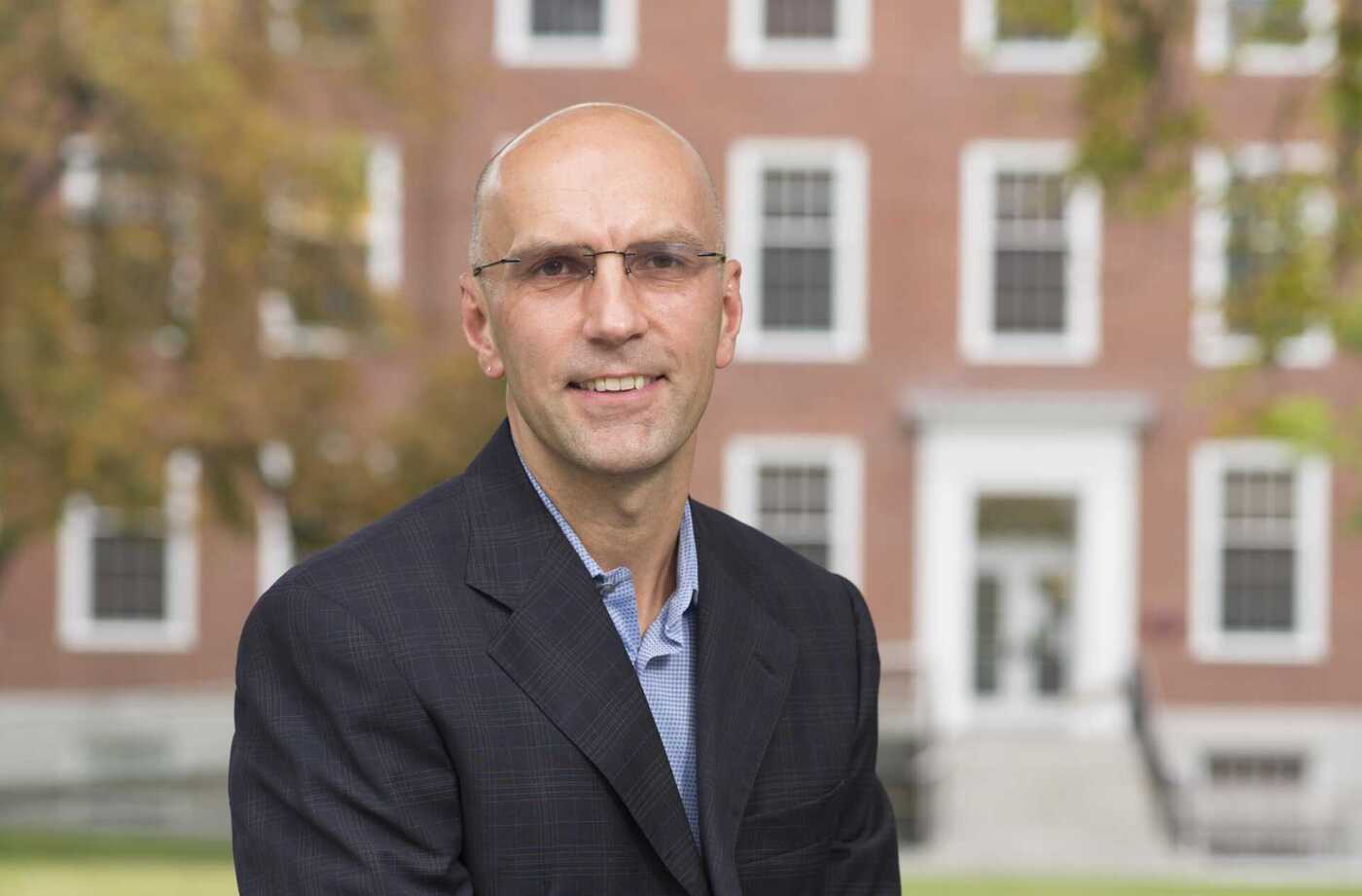
Hans Tutschkuis a German composer specializing in electroacoustic music, that is, one that takes shape from creative processes that require the participation of electronic or computer devices for sound generation, processing and organization.
He is an especially award-winning and internationally recognized author. He has won, among others, the Bourges Electroacoustic Music and Sound Art Award, the São Paulo International Electroacoustic Music Competition, and the Hanns-Eisler, Ars Electronica, Noroit and Musica Nova awards. He has also received an award from his native city of Weimar. More recently, he won first prize in the competition Klang! and in the competition of the International Confederation of Electroacoustic Music of the CIM/UNESCO.
He has taught at the Musical Acoustic Research and Coordination Institute (IRCAM) in Paris, held the post of Edgar-Varèse-Gastprofessor (guest professor) at the Technical University of Berlin and since 2004 he has been a professor of composition and director of the electroacoustic music studio at Harvard University.
In order to get closer to understanding the way composers use science and technology in their creations, Hans Tutschku compares the visual arts and music. He points out that if we stand in front of a sculpture, it is relatively easy to imagine, albeit inaccurately, a procedure of how the artist could have done it, but in music things happen that way. For people who don’t compose, the way a composer makes music is often a mystery. In general, we expect everything we feel to come from the ‘great’ inspiration of the creator; and because of the imaginary role surrounded by mystery that we ascribe to musicians and composers, we tend to neglect conceptions that attribute significant importance to the participation of science and technology in musical creation.
Hans Tutschku, however, draws important parallels between the ways of doing science and making music, based on the scientific method, which was first enunciated by Francis Bacon in the 16th century. There are similarities between scientific demonstrations and the process of realizing artistic ideas, and at this point he cites Karlheim Stockhausen, who considers a work is finished when his mental model is close enough to realization; when there is a minimal difference between model and realization. Think of the process of creating music as a recursive circle that starts from the practical realization of a first musical idea that is not necessarily outlined in all its details - a phrase, a sequence of chords, of sounds - that undergoes modification as a result of listening to it in a critical and reflective way. It is a reflection on the practical realization of the initial idea, but also on the formulation itself. In fact, consider reflection in terms of comparison. An idea that at first is vague or incomplete, as the creator applies his tools, gradually takes shape by virtue of a recursive work of exposure to critical listening and from there, to the transformation that ends up giving definitive form to the idea through its realization. The musical work is therefore also created in constant dialogue between it and the creator, as is the elaboration of scientific thought, which takes place in a universe parallel to that of the artists. For this reason, and because he sees the works as testimony to a specific way of thinking about his story, he never reviews them.
Science has always been linked to music. Bach himself could not have even thought of Das wohltemperierte Klavier without the technical and conceptual possibility of equal temperament. Today we can go a little further than that technological milestone; we have computers, machines, which, at first, were not considered musical instruments. But seen with sufficient perspective, we will realise that pianos, violins, flutes, in short, all musical instruments, where some see such human qualities, are also machines designed to perform precise tasks, like computers, which among other things, can give us very detailed information about gestures, a key element in the conception of musicality from Tutschku's point of view, who, as he does not believe in the automatic use of technology, but sees it as an aid, is not very attracted to the idea of a machine that makes music on its own by means of the implementation of algorithms, no matter how complex and elaborate they become.
His way of working involves the pre-recording of all kinds of sounds. Before applying artificial intelligence techniques, he listens to them critically in order to classify them. There comes a time, however, when the data are so numerous that without the participation of artificial intelligence it would be impossible to make meaningful choices based on the musical qualities of a large population of intervention-oriented sound events in contexts of great complexity. This is one of the points where the computer proves to be very useful. A choice made with these computational tools can result in a list of thousands of elements with the ability to participate in hundreds of polyphonic configurations or spatial ordering of sounds.
Asked about the role of uncertainty in his work, Hans Tutschku replies that he tends to create random selection fields; but that it does not look for static chances, but rather movements between various random configurations. His research on chance, by the way, one of the central elements of quantum mechanics as we see it today, engages the dialogue between repetition, which marks the strengthening of the identity of a musical material, and the difference between what perception is able to identify and what it is not in any way. In his case, chance is treated by means of a classical tool in electroacoustic music: filtering. Now, however, instead of being applied to more or less noisy sound materials, it configures the structure of the data between a set of pre-established limits in order to give a general shape to the temporal behaviour of the sound and musical materials involved in his pieces.