La performance fou plenament acceptada com a manifestació artística de dret a la dècada dels anys setanta del passat segle, quan es generalitzà la seva representació davant del públic. Compta amb nombrosos exemples d’artistes contemporanis que l’han practicat de forma molt diversa, com Josep Beuys, Bruce Nauman, Vito Acconci, Yoko Ono, Gilbert & George o, entre molts altres, Esther Ferrer. Tanmateix, els seus orígens remeten als primers moviments d’avantguarda que la practicaren com a forma d’introduir el pols de la vida a les seves creacions. Cent anys després, la performance posseeix encara aquella mateixa condició de ruptura i dissidència d’aquelles manifestacions que feren de l’artista -el seu cos, la seva veu, els seus moviments i emocions- l’element viu, “l’objecte”, que reclama la reacció del públic amb les seves accions, enllaçant les seves interpretacions tant amb pràctiques rituals ancestrals com amb el teatre i la dansa contemporànies.
LIFE DEATH INBETWEEN
Galeria Horrach Moyà, Palma. Fins al 17 de novembre de 2022
Comissària: Sydney Fishman
*Imatges: cortesia de la Galeria Horrach Moyà
Marina Abramovic (Belgrad, 1946) és una de les representants més influents i reconegudes de la performance, amb més de cinquanta anys de compromís infrangible amb els seus objectius i principis. D'una banda, experimenta amb el seu cos per dur-lo als seus límits i superar les seves pors més primàries: el dolor, el patiment i la mort. De l'altre, utilitza les seves obres com a catalitzador per tal que el públic prengui consciència de la seva pròpia força.
Un repàs a l’obra d'Abramovic revela que l’artista continua escrivint un dels capítols més destacats a les pàgines de l'art contemporani."Rythm 0" (1974) ja fou una encesa crítica contra la violència on posà la seva vida en perill per convidar el públic a utilitzar tota mena d'armes i utensilis contra el seu cos. Durant els anys de la seva col·laboració amb el seu company Ulay, varen crear junts nombroses performances arriscades i colpidores, incloent-hi la darrera, "The Lovers", que visualitzà l'acomiadament de la seva relació amorosa. Recentment, Marina Abramovic va dur a terme la devastadora "The Artist is Present" (2010) i la intensament emotiva "Les set morts de Maria Callas", un homenatge d’admiració als darrers anys de la diva de l’òpera.

Podríem dir que Marina Abramovic és a la performance el que Pina Bausch fou per a la dansa. Ambdues són figures clau per entendre l’expansió de les arts cap als territoris de la dansa i el teatre experimental i viceversa. Ambdues han deixat una marca indeleble als escenaris de l’art internacional per mostrar al món l’abast que pot tenir la força de voluntat de qui no es rendeix.
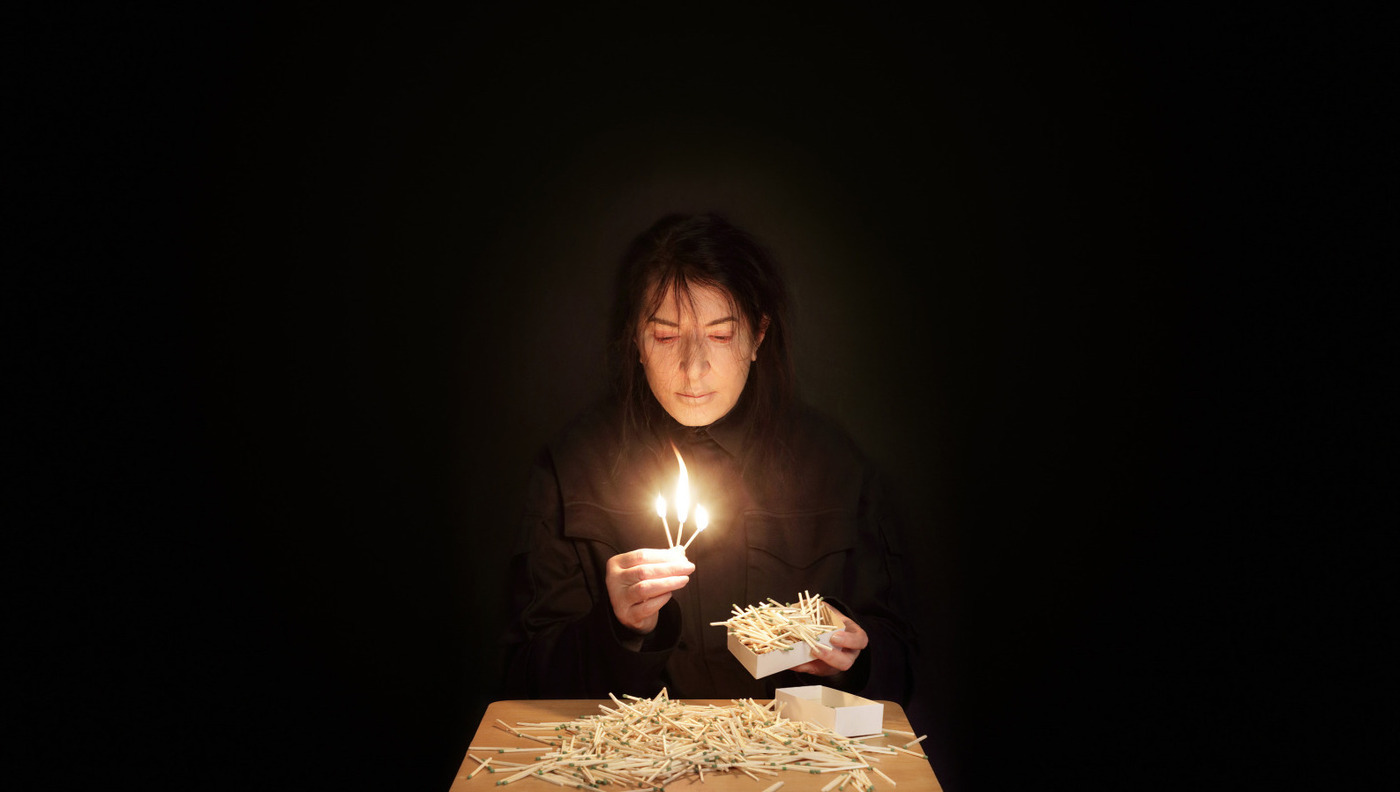
A més de la seva força, l’obra d’Abramovic posseeix qualitats estètiques excepcionals. Moltes de les seves fotografies tenen la profunditat i sensualitat de les grans pintures. Com a exemple, el seu recent “Retrat amb llumins” (2022) en què estableix una relació directa amb l’estètica del Barroc, mostrant el seu rostre il·luminat per llumins, mentre la major part de la composició roman en la foscor.
Molt activa mentre adapta el seu cos a l’avenç de l’edat, “únic límit real” que la condiciona actualment, Marina Abramovic ha comparegut novament a Palma de la mà de la Galeria Horrach Moyà, amb una mostra comissariada per Sydney Fishman que explora el qui hi ha entre la vida i la mort. El cuidat recorregut de la proposta, inclou una selecció de vídeos i fotografies de les seves performances més emblemàtiques, algunes molt directes -com aquella on menja plorant una ceba crua- i altres més ambivalents i misterioses -com quan jeu a terra al costat d’una foguera extinta a la selva del Brasil.

Observar els canvis de la mirada de l’artista és un exercici molt interessant i revelador. Pot romandre impassible malgrat la por o el rebuig. Un bon exemple és aquella performance en què passejava pel seu cos l’animal que més l’aterra, una gran serp. Abramovic sap molt bé com mostrar o amagar les seves emocions i és capaç de mantenir el seu rostre impenetrable davant les circumstàncies més estressants. La tristesa i la joia, com la bellesa i el terror o la vida i la mort, conviuen a l’obra d’aquesta anomenada “padrina” de la performance que afirmà que aquest art pot, com en el cas de la música considerar-se una “partitura” que poden interpretar i reinventar les noves generacions d’artistes. Però ningú com ella sap commoure’ns i suscitar la nostra empatia quan plora i mira a la càmera amb gran sentiment.

Molt propera en l’encontre de roda de premsa amb els medis locals, l’artista fou generosa en les seves respostes, aportant dades i anècdotes personals, com el seu genuí plor en escoltar per primer cop, a 14 anys, la veu de Maria Callas. “Jump”, de 2022 -títol de la fotografia que mostra el cos d’Abramovic suspès al buit mentre cau. És una imatge de gran bellesa extreta de la pel·lícula “Les set morts de Maria Callas”, que es va projectar a Palma en presència de l’artista.

En el nostre tercer encontre en més de vint-i-cinc anys, vaig poder demanar-li per alguns aspectes relacionats amb el tema de l’exposició. A la pregunta de si viure intensament incrementa el risc de morir, l’artista em respongué: “Mai he volgut morir, però sempre he volgut saber fins on podia arribar. En la vida, la mort pot arribar en qualsevol moment... Existeix una teoria que diu que si un és extremadament feliç, no pot morir” (...) “El que no vull -continuà- és morir perdent la consciència, ni per malaltia. El meu desig seria morir sense por ni estar enfadada. Tampoc m’agradaria morir i no saber que estic morta”.

No és tant la seva mort com la mort de les víctimes innocents el que mou a l’acció Marina Abramovic. Quan anà a Laos i s’interessà per la situació dels nins soldats, va crear la sèrie de retrats en què apareix vestida amb robes militars mentre sosté entre els seus braços -com si fos un cistell de flors- diferents armes de guerra, que tantes morts estan segant i destruint.

És aquesta mateixa empatia amb el dolor aliè el que encoratjà el seu darrer projecte: la construcció d’un gran mur de cristalls a Ucraïna que recorda l’horror de l’Holocaust i el que no hauria de tornar a passar: les morts dels innocents.Utilitzant l’energia dels cristalls Abramovic emfatitza un aspecte essencial del seu treball: la seva creença en la curació, la redempció i la renovació. Aquest és el missatge que es desprèn de la fotografia que mostra l’artista amb els ulls oberts, còmode i serena amb tot el seu cos cobert de cristalls.
De fet, tot el treball d'Abramovic respon a una convicció, que "l'art és una necessitat per a la humanitat, tant en l'àmbit espiritual com moral, però necessita que hi hagi herois i heroïnes". Abramovic reconegué que es creix davant les dificultats i que com més difícil és la performance més forta se sent, "ja no soc -digué- la petita Marina que plora". Malgrat la seva fortalesa apresa a tants anys de sacrifici físic, mental i espiritual, reconegué un punt feble: "tot em fa plorar. Si veig una pel·lícula i no em fa plorar, penso que no és bona". I, com ella, tots plorem de vegades no tan sols per un únic motiu o desgràcia, sovint "acumulem" plors que alliberem de cop.

Una de les darreres qüestions a Marina Abramovic es referia a un altre tipus de patiment extrem: el de la ment i l’esperit que li produí la seva experiència a “The Artist is Present”, una de les seves performances de més dures, que li exigí passar tres mesos, vuit hores al dia asseguda a una sala del MOMA de Nova York mantenint un contacte visual silenciós amb milers de visitants. L’artista em digué “Fou un infern. Cada dia pensava que era l´últim, que no podria més... però en la meva naturalesa no hi ha lloc per l’abandó”. Tanmateix, Abramovic va arribar final asseguda davant el seu darrer visitant, Ulay, tancant públicament aquell episodi dolorós del seu trencament amorós per obrir, simbòlicament, un nou capítol en la seva relació.
No debades, Marina Abramovic creu en l’amor molt més encara que creu en la mort com extrem necessari de la vida. Ella que ha experimentat tota mena de situacions i que ha dut les seves pors i les seves experiències a l’escena, convertint-los en vertaders rituals de curació personal i col·lectiva, és la millor prova de la possibilitat de conjurar tot allò que ens ferma i condiciona la nostra vida. Per això advoca per la pervivència de la performance “un tipus d’art que no morirà mai, doncs és com l’Au Fènix que pot renéixer de les seves cendres”.
ENGLISH TRANSLATION
MARINA ABRAMOVIC: THE ARTIST THAT NEVER GIVES UP
“LIFE DEATH INBETWEEN”
Galeria Horrach Moyà, Palma. Closing 17th November, 2022
Curator: Sydney Fishman
Photographs courtesy of Galeria Horrach Moyà
By the 1970s, performance art was completely accepted as a valid art form, with artists frequently acting in public. There are many examples of contemporary artists who have successfully used different forms of performance art: Joseph Beuys, Bruce Nauman, Vito Acconci, Yoko Ono, Gilbert & George andEsther Ferrer, amongst others. However, performance’s origins date from the beginning of the 20th century, when avant-garde movementsrecognisedits possibilities to connect everyday life with their living actions. A hundred years later, performance still embodies the same sense of rupture and dissidence born in those pioneering examples that rendered the artists -withtheir body, voice, movements and feelings- the living element, “the object” that elicits the audiences’ reaction and thus links their interpretations to both ancestral ritual practices and contemporary theater and dance.
Marina Abramovic (Belgrade, 1946) is one of the most influential and prestigious performers, with more than fifty years of steadfast commitment to its goals and principles. On the one hand, she experiments with her body to push it to its limits and overcome primal fears such as, pain, suffering and death. On the other, she uses her works as a catalyst, stimulating people to become aware of their own strength. An overview of Abramovic’s trajectory reveals her unwavering artistic engagement as she still continues writing outstanding chapters of Contemporary Art. “Rhythm 0” (1974), was a radical piece denouncing violence, one that endangered her own life as she invited the audience to use all sort of weapons and dangerous devices on her body. During the years of collaboration with her partner, Ulay, they created many intense, risky performances, including the last one, “The Lovers”, which visualized the end of their love relationship. More recently, Marina Abramovic performed the devastating “The Artist is Present” (2010) and the emotionally demanding “The seven deaths of Maria Callas”, a moving tribute to the last years of the opera diva.
One could say that Marina Abramovic is to performance what Pina Bausch was to dance. Both artists are key to understanding the meaningful expansion of the arts towards both theater and dance and vice versa. Abramovic and Bausch have left equally indelible marks on the international contemporary art scene, demonstrating to the world the scope of the willpower of those who never give up. In addition to its strength, Abramovic’s work possesses exceptional aesthetic qualities. Many of her photographs show a depth and sensuality similar to that of great paintings. An example is her recent “Portrait with candles” (2022), a wonderful exercise that imitates the Baroque dramatic sense of illumination, with only her face illuminated by lighted candles and most of the composition in darkness.
Very active whilst adapting her body to advancing years -“the only real limit” that currently conditions her -, Marina Abramovic is appearing once again in Palma in an exhibition that explores what exists in between life and death, a show curated by Sydney Fishman for Horrach Moyà Gallery. The carefully selected pieces include videos and photographs of some of the artist’ most emblematic performances. Some are very striking, such as one when she is eating a raw onion while her tears fall silently; others are more ambivalent and mysterious, like the one that shows her sleeping by a fire pit in a wild forest in Brazil.
Observing the changes in the artist’ gaze is a very interesting, revealing exercise. She can remain impassive despite fear or rejection. As an example, there is the famous performance when she played with a big snake coiled around her body. Abramovic knows how to show or hide her emotions and is capable of keeping her face impenetrable even under the most extreme stress. Sadness and joy, like beauty and terror or life and death, coexist in the work of the so-called “Godmother of Performance”, who affirms that this art may, as in the case of a musical score, be interpreted and reinvented by new generations of artists. However, no one can equal her in her ability to impress us and arouse our empathy when she looks into the camera and reveals the drama of her intense feelings.
In our third encounter in more than twenty-five years, I was able to ask Marina Abramovic about some aspects related to the theme of the exhibition. To my question “whether “living intensely increases the aversion to dying”, she answered: “I never wanted to die, but I always wanted to know how far I could go. In life, death can come at any moment… There is a theory that says that if one is extremely happy one cannot die” (…) “What I don’t want -she continued- is to die losing consciousness or due to illness. My wish would be to die without fear or anger. Nor I would like to die and not know that I am dead”.
It is less about her own death than the death of victims that moves Marina Abramovic to action. When she went to Laos to learn first-hand about the child-soldiers’ situation, she created a series of portraits, with her dressed in military uniform whilst holding – as if they were flowers in a basket – various weapons of war, weapons which kill and destroy so many lives.
Her empathy with the pain of others is what fostered the artist’s last project, the construction of a big wall of crystals in Ukraine. This work evokes the horror of the Holocaust and reminds us of what should never happen again: the death of innocents. By using the energy of crystals, Abramovic emphasizes a key aspect of her thinking, namely her faith in healing, redemption and renovation. This is the clear message she gives in the performance photograph showing the artist’s body, eyes opened, calm and comfortable, totally covered by crystals.
In fact, Marina Abramovic’s entire body of work is aligned with her artistic ideology, as expressed here in her own words: “Art is a need for mankind, both at spiritual and moral levels. But it is necessary that there are heroes”. The artist acknowledged that when faced with difficulties, she gains strength; the more difficult a performance, the stronger she feels. “I am not anymore”, she continued, “little Marina crying”. However, despite acquiring that strength through many years of physical, mental and spiritual sacrifices, she recognizes a weakness: “Everything makes me cry. If I see a film and I don’t cry, I think it is a bad film”. Just like her, we all need to cry from time to time to rid ourselves of our accumulated sorrows.
One of the last questions I put to Marina Abramovic was about another form of extreme suffering: that of the mind and spirit during her experience in “The Artist is present”. This performance required her being seated in a chair in front of an empty table for three months and eight hours a day in a room at MOMA, while maintaining silent visual contact with thousands of visitors. She said: “It was hell. Every day I thought was the last, that I was done… but in my nature there is no chance to give up”. In fact, Abramovic reached the end of the performance seated in front of her last visitor, Ulay, publicly closing the painful episode of their break up and thus symbolically opening up a new chapter in their relationship.
Marina Abramovic believes that love, rather than death, is the necessary opposite to life. She has experimented with all kind of situations and has revealed her fears and hopes in public performance, making them true personal and collective rituals of healing. Her life and work are the clearest proof that we can all transcend our limitations and achieve success. Small wonder that she claims that performance art will survive for it is “a kind of art that will never die, because it is like the Phoenix Bird, that may always reborn from ashes”.